


Paul B
NJRC Member
OK, when you stop laughing, I will explain why I think a reverse undergravel filter is the best thing since doorknobs.
First, I will explain what a RUGF (reverse undergravel filter is.
Right after WW2, the aquarium hobby came into being in earnest. Our troops came home from the war, and they wanted a hobby. Many people started freshwater fish tanks and their kids soon followed. I was one of those kids and started my first tank around 1953. The tanks were metal-framed and sealed (not very well) with tar, since silicone hadn't been invented yet.
Virtually all of those tanks ran an undergravel filter as I did. We did have problems because the hobby was new, and no one knew much about keeping fish, but we did know, from the little bit of information available, that the fish needed oxygen and filtration. The undergravel filter solved both issues and did it cheaply and efficiently.
The UGF is basically a plate with holes in it that sits under the gravel and a little over the bottom glass. (At the beginning, the bottom of the tanks were slate)
A tube was inserted in it, and you put an airstone in the tube, forcing the water to come up and allowing the water to go down through the gravel and up the tube. This effectively filtered particles out of the water and created circulation, allowing oxygen from the surface to enter the water.
This worked great for a few years, but after a while the filter clogged, causing the oxygen to stop and creating anaerobic conditions that eventually killed everything and stank up the house. Luckily, we were young then and not married, or we would have gotten divorced, and our Xes would have taken our house, car, and all the dead fish.
We soon learned that occasionally we had to remove everything from the tank and wash the gravel.
Fast forward to salt water. Salt water fish first came out in Germany and a couple of years later in the US. I came home from Vietnam in 1971 and saw my first saltwater fish for sale, and I had to have one. I set up my 40-gallon tank with an undergravel filter because that's what we knew, and nothing else was available.
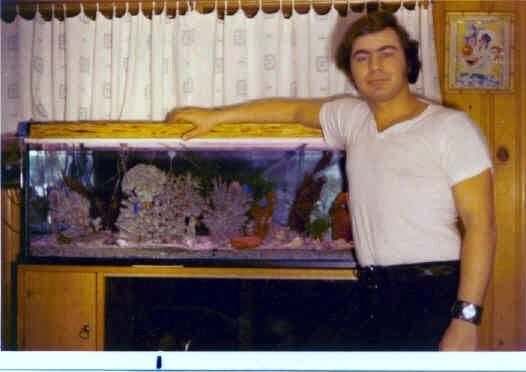
Circa 1972 (I still look exactly the same, including my hair and watch)
Remember, there were no salt water books except one by "Robert Straughn" (The Father of Salt Water Fish Keeping)
Also, no computers, cell phones, or internet.
He recommended using undergravel filters, but at the time, the early 50s, he didn't know about or fully understand the function of bacteria in a salt tank and used the UG filter as a particle filter, as we used them in fresh water. He recommended removing the filter occasionally and cleaning the gravel.
That worked in a fish-only tank, but with a reef tank, where corals covered everything, that was not possible, as I found out the hard way, and my tank almost crashed from hydrogen sulfide, which is black, and it stinks like rotten eggs. Luckily, I wasn't married yet.
I did some experimenting and discovered that if I reversed the flow through the undergravel filter and instead of sucking water through it, I instead pushed water up through it from the bottom, the thing worked much longer with very little maintenance.
I had some failures until I came upon the correct flow rate, as too much flow will also cause it to crash due to detritus clogging the gravel.
Through a few years of experimentation, I learned that about 250 GPH pushed down "each" tube was perfect. (My reef is 125 gallons, is 6' long, and uses 3 undergravel plates)
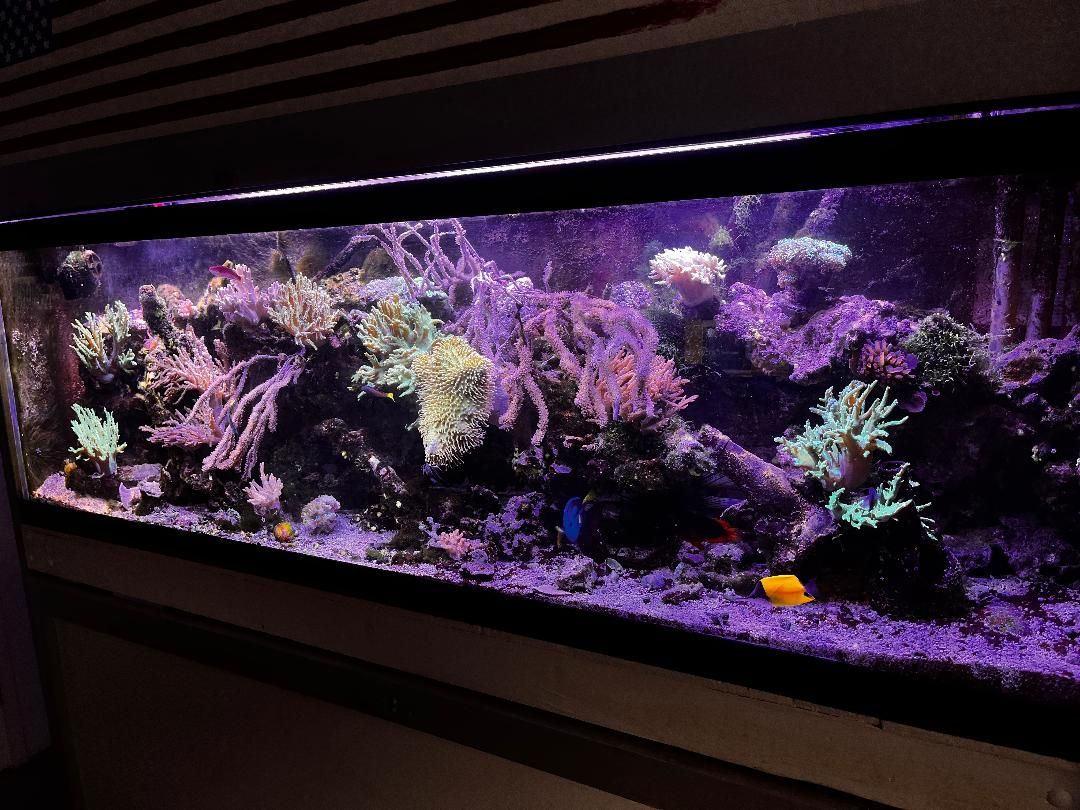
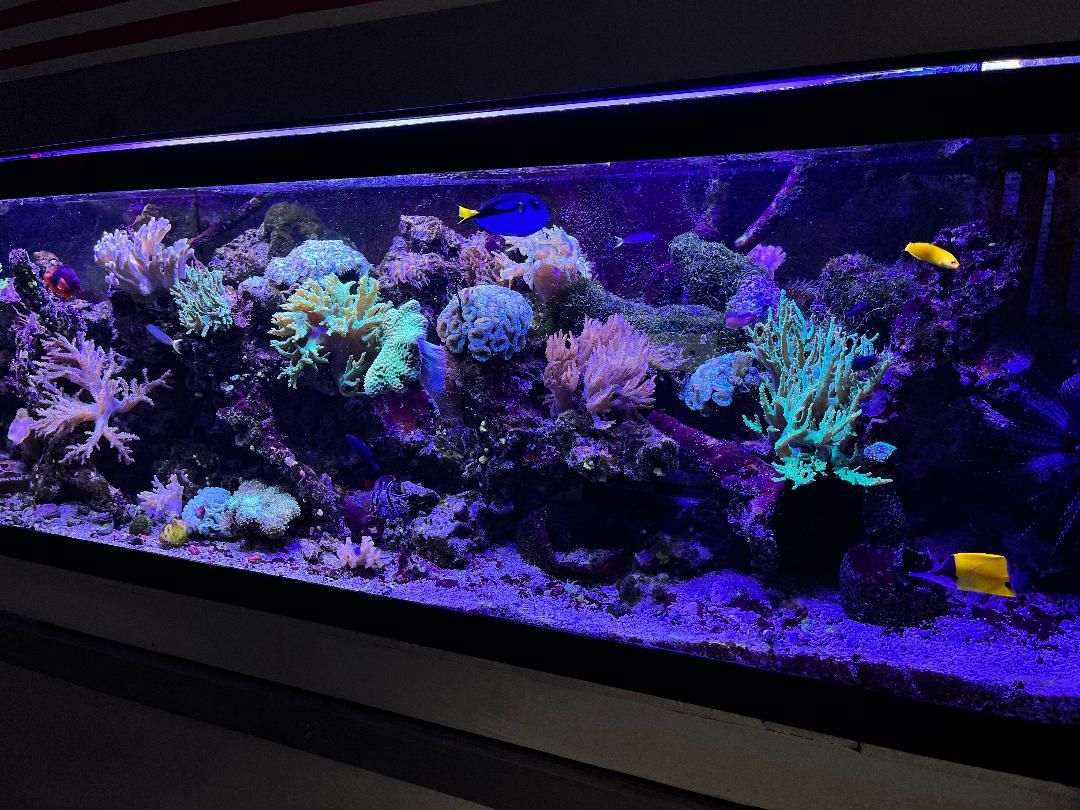
My still-running 55-year-old reef tank has had very few, if any, problems, but it does need a little maintenance. First off, sand can't be used as it is too fine, so I use dolomite gravel, which is about the size of rice. I think crushed coral would work fine.
For 20 years that tank ran fine but at that time I wanted to replace my rocks and re-aquascape mostly for aesthetic reasons and I really wanted to see what was under that filter.
It was mostly muck with thousands of tiny, red tube worms. Those are good signs, meaning there is still oxygenated water flowing through there with enough food to keep those creatures alive. The fact that they are living also means they are filtering out microscopic particles that would float around in my tank.
I cleaned the gravel by stirring it up and running a powerful canister filter to remove excess detritus. I didn't remove the gravel to wash because I wanted to retain those organisms and keep the bacteria.
Bacteria run our tanks, and we are only there to give the bacteria something to make fun of. That is why new tanks look lousy and are never healthy. The bacteria make the water healthy and livable, but it takes time to get to that state.
My tank ran another 20 years in that house, so 40 years in total and at that time my wife and I moved about 50 miles out to eastern Long Island. I put everything in the tank in large vats, including most of the water, and had to remove the RUGF.
Here is my son-in-law lifting the RUGF for the move. Notice the muck.
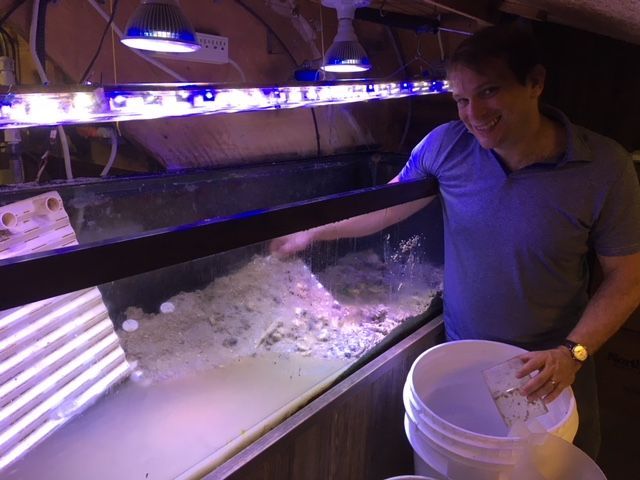
As I mentioned, a reverse undergravel filter needs maintenance. That maintenance is that the gravel needs to be cleaned, but not drastic like in fresh water. It just needs to be stirred by using a powerful canister filter and sucking out excess detritus. That's it.
The vast majority of reef tanks today use sand or even a deep sand bed. I don't like those systems, and as far as I know, none of them are really old, as nothing lasts without maintenance, and those setups can't be well cleaned efficiently because doing so may release harmful hydrogen sulfide, which cannot form with a RUGF.
The only really old tanks I know of, which are over 30 years old, use RUGFs. I am not saying sand substrates can't work. Of course, they can, but I feel they have a definite lifespan, and I started this hobby to be a lifetime endeavor and not a temporary thing.
Remember, it's the bacteria that run our tanks and most, (but not all) bacteria need oxygen. If it didn't work, my tank, which has never crashed, would not exist.
First, I will explain what a RUGF (reverse undergravel filter is.
Right after WW2, the aquarium hobby came into being in earnest. Our troops came home from the war, and they wanted a hobby. Many people started freshwater fish tanks and their kids soon followed. I was one of those kids and started my first tank around 1953. The tanks were metal-framed and sealed (not very well) with tar, since silicone hadn't been invented yet.
Virtually all of those tanks ran an undergravel filter as I did. We did have problems because the hobby was new, and no one knew much about keeping fish, but we did know, from the little bit of information available, that the fish needed oxygen and filtration. The undergravel filter solved both issues and did it cheaply and efficiently.
The UGF is basically a plate with holes in it that sits under the gravel and a little over the bottom glass. (At the beginning, the bottom of the tanks were slate)
A tube was inserted in it, and you put an airstone in the tube, forcing the water to come up and allowing the water to go down through the gravel and up the tube. This effectively filtered particles out of the water and created circulation, allowing oxygen from the surface to enter the water.
This worked great for a few years, but after a while the filter clogged, causing the oxygen to stop and creating anaerobic conditions that eventually killed everything and stank up the house. Luckily, we were young then and not married, or we would have gotten divorced, and our Xes would have taken our house, car, and all the dead fish.
We soon learned that occasionally we had to remove everything from the tank and wash the gravel.
Fast forward to salt water. Salt water fish first came out in Germany and a couple of years later in the US. I came home from Vietnam in 1971 and saw my first saltwater fish for sale, and I had to have one. I set up my 40-gallon tank with an undergravel filter because that's what we knew, and nothing else was available.
Circa 1972 (I still look exactly the same, including my hair and watch)
Remember, there were no salt water books except one by "Robert Straughn" (The Father of Salt Water Fish Keeping)
Also, no computers, cell phones, or internet.
He recommended using undergravel filters, but at the time, the early 50s, he didn't know about or fully understand the function of bacteria in a salt tank and used the UG filter as a particle filter, as we used them in fresh water. He recommended removing the filter occasionally and cleaning the gravel.
That worked in a fish-only tank, but with a reef tank, where corals covered everything, that was not possible, as I found out the hard way, and my tank almost crashed from hydrogen sulfide, which is black, and it stinks like rotten eggs. Luckily, I wasn't married yet.
I did some experimenting and discovered that if I reversed the flow through the undergravel filter and instead of sucking water through it, I instead pushed water up through it from the bottom, the thing worked much longer with very little maintenance.
I had some failures until I came upon the correct flow rate, as too much flow will also cause it to crash due to detritus clogging the gravel.
Through a few years of experimentation, I learned that about 250 GPH pushed down "each" tube was perfect. (My reef is 125 gallons, is 6' long, and uses 3 undergravel plates)
My still-running 55-year-old reef tank has had very few, if any, problems, but it does need a little maintenance. First off, sand can't be used as it is too fine, so I use dolomite gravel, which is about the size of rice. I think crushed coral would work fine.
For 20 years that tank ran fine but at that time I wanted to replace my rocks and re-aquascape mostly for aesthetic reasons and I really wanted to see what was under that filter.
It was mostly muck with thousands of tiny, red tube worms. Those are good signs, meaning there is still oxygenated water flowing through there with enough food to keep those creatures alive. The fact that they are living also means they are filtering out microscopic particles that would float around in my tank.
I cleaned the gravel by stirring it up and running a powerful canister filter to remove excess detritus. I didn't remove the gravel to wash because I wanted to retain those organisms and keep the bacteria.
Bacteria run our tanks, and we are only there to give the bacteria something to make fun of. That is why new tanks look lousy and are never healthy. The bacteria make the water healthy and livable, but it takes time to get to that state.
My tank ran another 20 years in that house, so 40 years in total and at that time my wife and I moved about 50 miles out to eastern Long Island. I put everything in the tank in large vats, including most of the water, and had to remove the RUGF.
Here is my son-in-law lifting the RUGF for the move. Notice the muck.
As I mentioned, a reverse undergravel filter needs maintenance. That maintenance is that the gravel needs to be cleaned, but not drastic like in fresh water. It just needs to be stirred by using a powerful canister filter and sucking out excess detritus. That's it.
The vast majority of reef tanks today use sand or even a deep sand bed. I don't like those systems, and as far as I know, none of them are really old, as nothing lasts without maintenance, and those setups can't be well cleaned efficiently because doing so may release harmful hydrogen sulfide, which cannot form with a RUGF.
The only really old tanks I know of, which are over 30 years old, use RUGFs. I am not saying sand substrates can't work. Of course, they can, but I feel they have a definite lifespan, and I started this hobby to be a lifetime endeavor and not a temporary thing.
Remember, it's the bacteria that run our tanks and most, (but not all) bacteria need oxygen. If it didn't work, my tank, which has never crashed, would not exist.